Why AI Is Becoming Mandatory for Brokerages in 2026
The competitive dynamics in US residential real estate have shifted decisively. According to the National Association of Realtors, 75% of brokerages now use at least one AI tool in their operations, up from under 40% three years ago. Among individual agents, a 2025 Inman Intelligence survey found 97% report using AI-assisted tools in some capacity, primarily for CRM automation, content generation, and lead follow-up sequencing.
The benchmark that matters most: a Harvard Business Review study analyzing 2,241 US companies found leads contacted within 5 minutes convert at 9x the rate of leads reached after 30 minutes. In competitive markets like Texas, Florida, and California — where multiple agents often pursue the same lead simultaneously — that window closes faster than most brokerages acknowledge. The majority still respond in hours, not minutes.
Commission compression compounds the pressure. Buyer-side structures have faced renegotiation following NAR settlement changes effective in 2024, reducing guaranteed buy-side income for many teams. Lead acquisition costs have risen 35–50% across major portals since 2022. Agencies that relied on volume to absorb operational inefficiency are now confronting those margins directly. In 2026, AI adoption is not a technology decision — it is a margin protection decision.
AI-driven automation is delivering similar ROI across other industries as well. For example, e-commerce businesses using AI for cart recovery, personalization, and support automation are reporting significant revenue lift — see our detailed breakdown in AI Tools for E-commerce Store Owners (2026).
- Brokerage adoption: 75% of brokerages now use at least one AI tool in their operations, up from under 40% three years ago, per the National Association of Realtors.
- Agent adoption: 97% of individual agents report using AI-assisted tools in some capacity, per a 2025 Inman Intelligence survey.
- Speed-to-lead impact: Leads contacted within 5 minutes convert at 9x the rate of leads reached after 30 minutes, per Harvard Business Review research on 2,241 US companies.
- Acquisition cost pressure: Lead acquisition costs have risen 35–50% across major portals since 2022, per industry benchmarks.
Where Real Estate Agencies Lose Commission
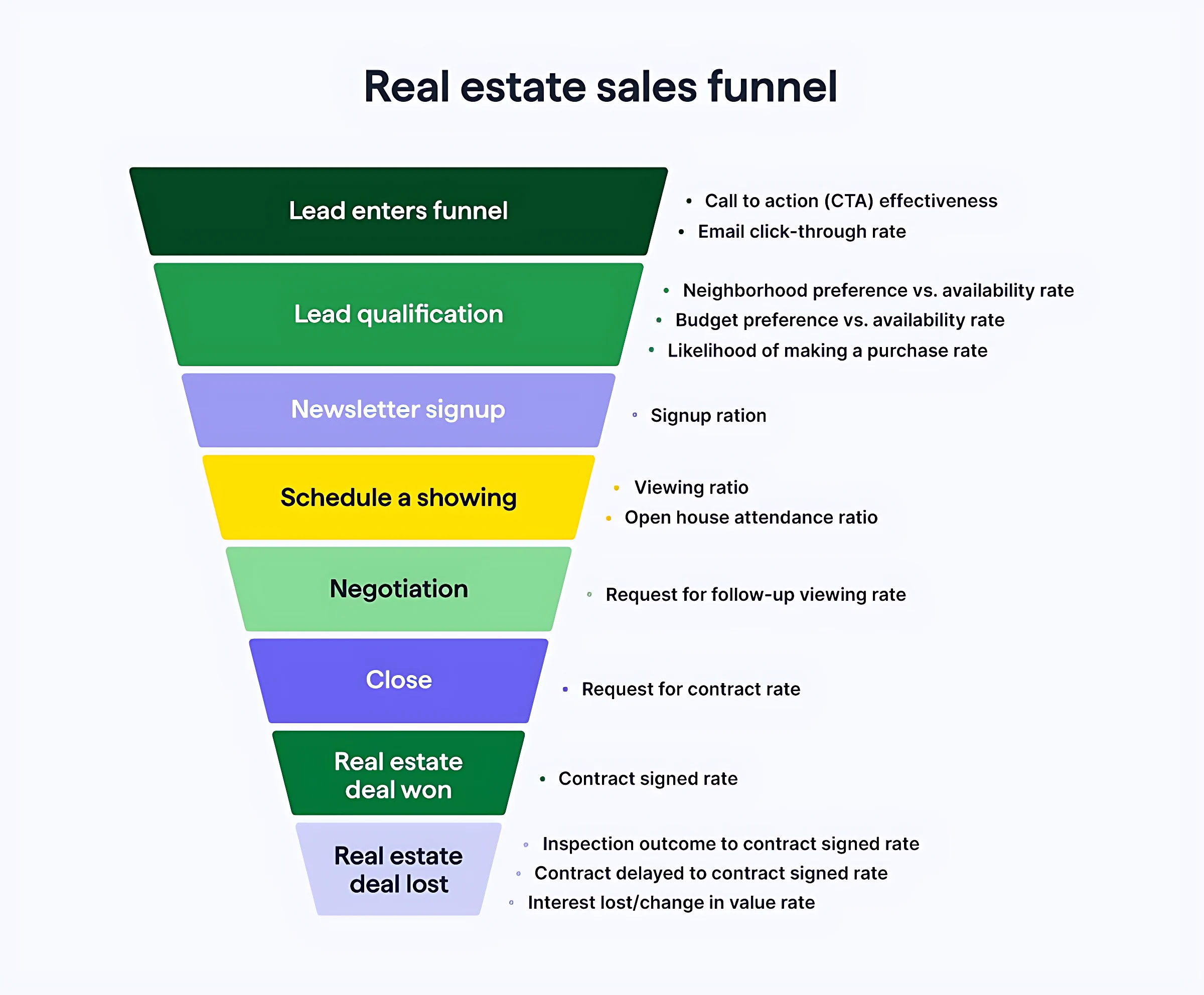
The standard real estate sales funnel highlighting the critical stages where lead drop-off typically occurs.
Benchmarks below reflect publicly reported industry data from NAR, Zillow, MIT, and InsideSales.com. Individual results vary by lead source quality, market conditions, and agent execution.
1. Slow Lead Response A brokerage receiving 100 leads per month at a 3% close rate generates 3 closings at $8,000 average commission — $24,000 per month in GCI. MIT and InsideSales.com research across more than 15,000 US leads found calling within 5 minutes makes contact 100 times more likely than calling at 30 minutes. A 0.5% close rate drop from chronic slow response removes 1.5 closings per month — $12,000 monthly, $144,000 annually. In teams managing 100–300 inbound leads per month, this pattern is consistent and measurable. AI delivering a qualified response in under 2 minutes is a six-figure annual revenue protection mechanism.
2. Manual Follow-Up Fatigue Zillow and Realtor.com data indicates the average home buyer requires 8–12 touchpoints before committing to an agent. In practice, CRM activity logs across mid-sized brokerages show follow-up completion dropping sharply after day seven — most agents make 2–3 attempts and move on. On a 10-agent team handling 200 leads per month, 60–70% of leads receive fewer touches than conversion requires: 3–5 potential closings dying monthly in the nurture gap. At $8,000 per closing, that is $24,000–40,000 per month in commission leakage traceable to manual follow-up limits.
3. Poor Lead Routing in Teams Lead assignment based on rotation or manual triage rarely optimizes for agent-lead fit. A high-intent buyer matched to a listing specialist, or a luxury inquiry routed to a volume generalist, measurably reduces conversion. A less obvious friction: agents receiving mismatched leads respond more slowly, compounding the response-time problem. One misrouted closing per month costs $8,000–12,000 in commission plus the opportunity cost of a misdirected interaction.
4. No Predictive Seller Identification The highest-margin lead is the off-market listing opportunity — a potential seller identified before publicly signaling intent. Without predictive tools, agencies wait for sellers to self-select through portals, entering a competitive market at the same moment as every other brokerage. One additional listing per month at 2.5% commission on a $450,000 sale represents $11,250 in gross commission invisible to non-predictive operations.
5. Inconsistent Transaction Coordination Industry data places contract fall-through rates at 15–20% of pending transactions nationally. Missed inspection deadlines, delayed lender documents, and unresolved contingency communications drive a significant share of those failures. For an agency managing 10 pending transactions, a 10% fall-through reduction through AI-assisted deadline monitoring preserves approximately one closing per month: $8,000–11,000 in commission that would otherwise revert to zero.
Speed-to-lead is the single highest-ROI problem to solve first. A sub-2-minute AI response operating 24 hours a day protects the commission leak that every other tool assumes you've already fixed. Deploy CRM and AI qualification before any other investment.