A step-by-step AI implementation framework for small businesses in 2026.Proven ROI examples, workflow redesign guidance, and cost breakdowns included.
In This Article
The Reality of AI Implementation in Small Businesses#
Artificial intelligence is no longer a future trend—it's a present-day competitive advantage separating thriving businesses from struggling ones.
According to McKinsey's Global AI Research, 88% of organizations use AI in at least one business function, while 58% of SMBs have adopted generative AI tools. Yet only 8.8% of small businesses achieve full AI integration across workflows.
Most businesses experiment with AI. Very few operationalize it effectively.
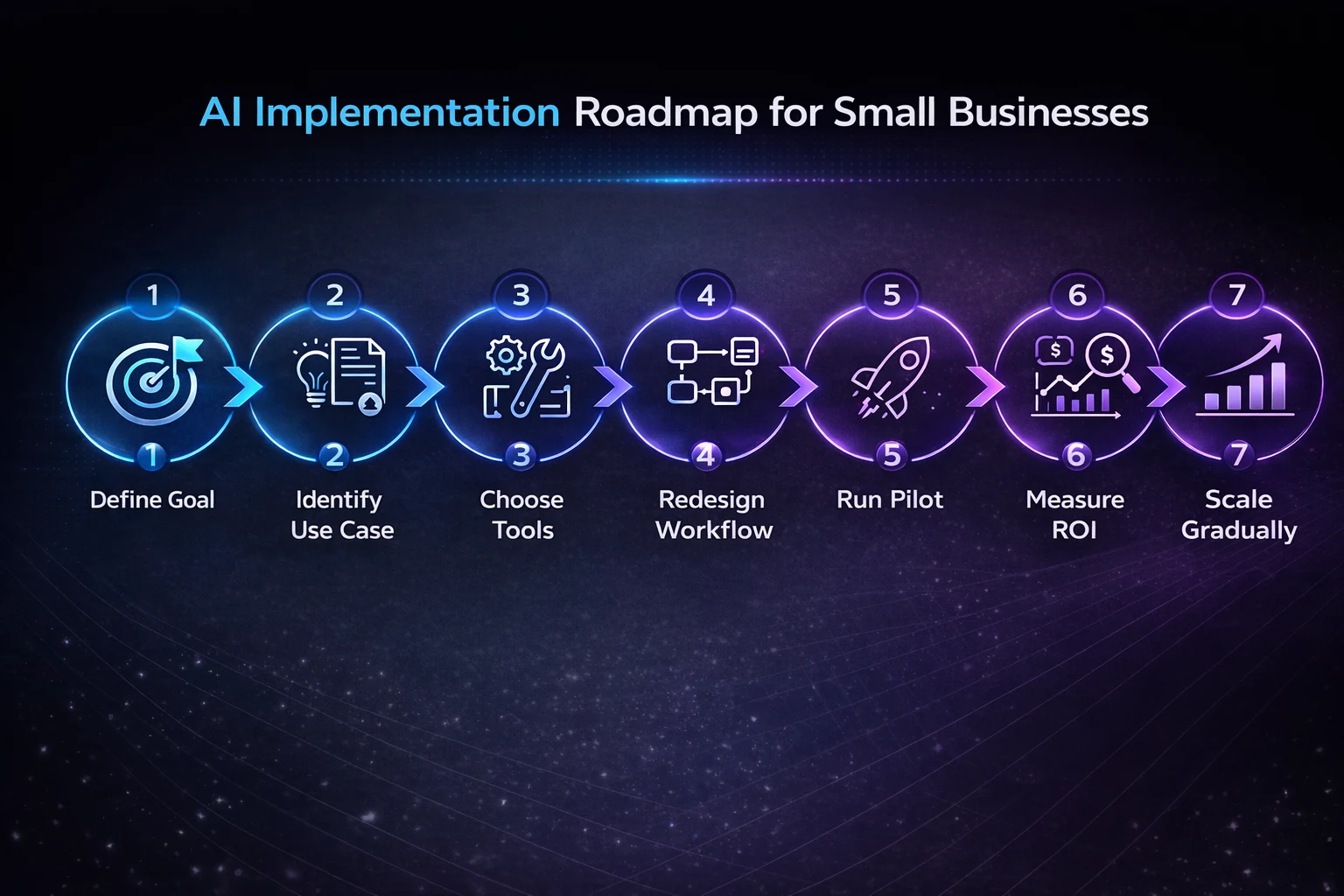
This guide provides a practical seven-step framework for small business owners to move beyond experimentation toward measurable ROI—without wasting budget or time on failed initiatives.
Never start with software. Weak goals lead to unfocused tool purchases, zero measurement, and eventual cancellation—contributing directly to the 70–85% failure rate.
Every implementation must connect directly to revenue growth, cost reduction, or time savings.
The right use case determines whether your pilot succeeds or fails before you spend a dollar on tools. High-impact AI use cases share three traits: they happen frequently, they follow predictable patterns, and their outputs can be verified quickly by a human.
AI assists in these areas—it cannot make final decisions without qualified human review.
💡 Pilot Selection Example
A customer support email workflow that receives 200 identical questions per week is a strong pilot candidate. It's frequent, pattern-consistent, and easily verified. A contract negotiation workflow is not.
This step separates successful implementations from subscription waste. Gartner predicts that
by 2026, over 80% of enterprise software will embed AI as core features—requiring
fundamental workflow thinking, not tool addition.
Most teams skip this step entirely, drop a tool into an unchanged workflow, and wonder why results are marginal. The process must be rebuilt around AI's strengths.
Audit your current workflow first.
For each step in your process, ask three questions:
Is this step triggered by a predictable input?
Does completing it require contextual human judgment?
Could an error here cause a significant customer or compliance problem?
Steps that are predictably triggered, require minimal judgment, and carry low error risk are prime targets for AI. Steps that fail any of those tests remain human-controlled.
Never deploy company-wide initially. Real implementation always reveals unexpected challenges that are only visible during actual use—not during demos or planning.
Selecting the right pilot team: Choose people willing to report problems honestly—not the most enthusiastic AI advocates. Enthusiastic adopters smooth over friction that will create larger problems at scale. You need accurate signal, not positive signal.
Week-by-week approach:
Week 1: Observe only. Document every friction point, workaround, and unexpected output. Don't optimize yet.
Weeks 2–4: Adjust the workflow based on Week 1 observations. Begin tracking KPIs.
Weekly check-in agenda:
What worked as expected?
What produced unexpected results?
What required manual override?
What data is missing from tracking?
Example metrics by use case:
Use Case
Metrics to Track
Customer Support
Response time, resolution rate, satisfaction score
Sales
Lead response time, meeting booking rate, pipeline velocity
Content
Pieces published, time per piece, engagement metrics
Operations
Hours saved, error reduction, process completion time
Only 25% of businesses clearly measure AI ROI, directly contributing to the 70–85% failure rate. Without measurement, you cannot distinguish success from expensive experiments—and you have no business case for expansion.
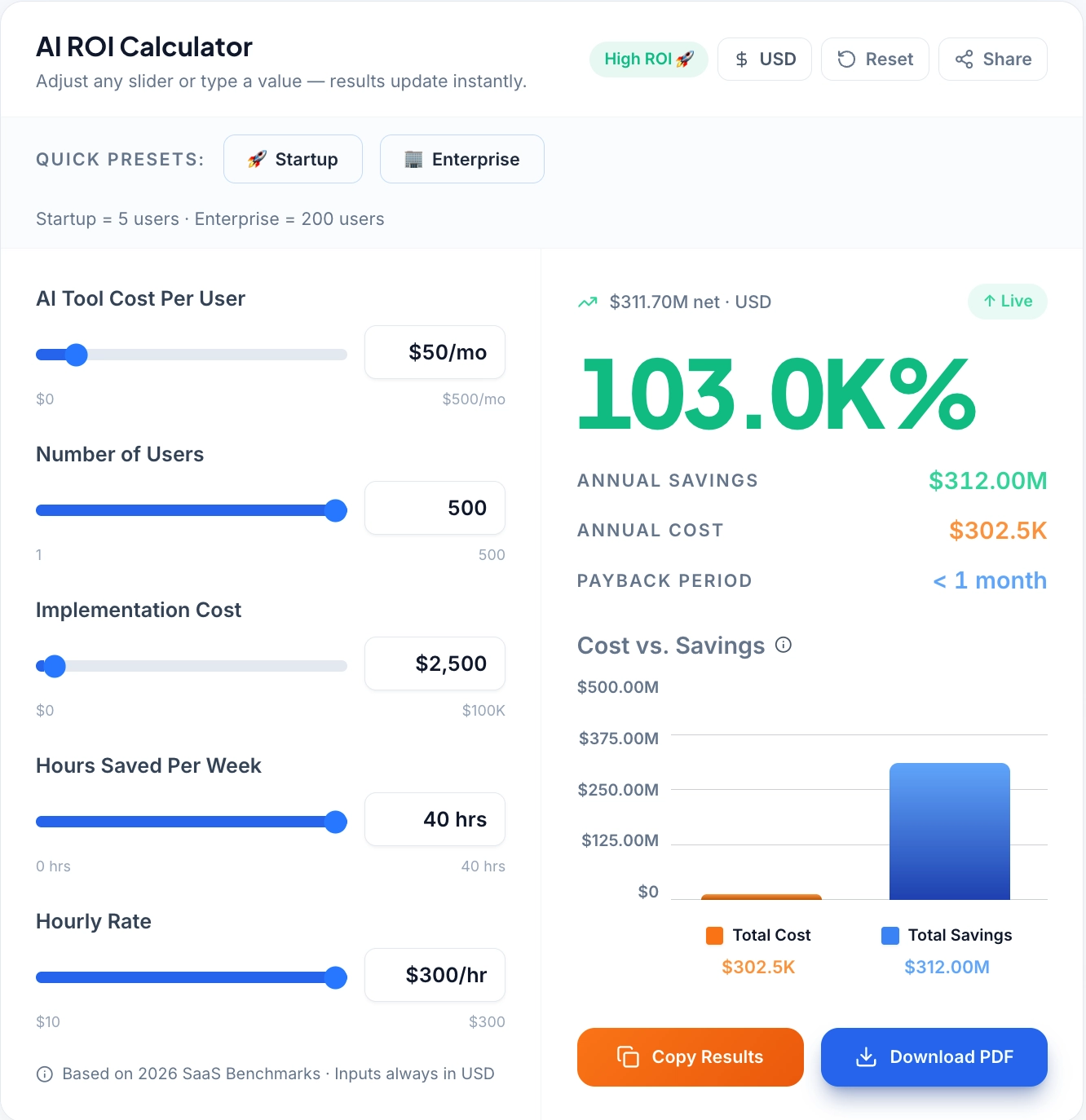
→ Want to model your own numbers? Use the AI ROI Calculator to calculate your projected returns before committing to any tool.
Quantifying Value: Use the AI ROI Calculator to forecast potential savings and payback periods based on your specific team size and hourly rates.
Real-World Example: Landscaping Business
Item
Cost
Chatbot
$49/month
Email automation
$29/month
Setup (amortized)
$200/month
Training (one-time)
$300
First month tota
$578
Ongoing monthly
$278
Return Source
Monthly Value
Admin time saved (18 hrs × $25)
$450
Additional bookings
$1,200
Recovered missed opportunities
$800
Total monthly return
$2,450
First month ROI: 324% | Ongoing ROI: 781%
The largest ROI driver often isn't time savings—it's captured revenue that previously fell through
the cracks. Missed after-hours calls, slow follow-up, and unanswered inquiries represent
invisible losses that only become visible when AI makes the comparison measurable.
Businesses that scale too quickly experience 3–4x higher failure rates. The institutional knowledge that made your pilot succeed lives in your pilot team's heads—unless you extract it before expanding.
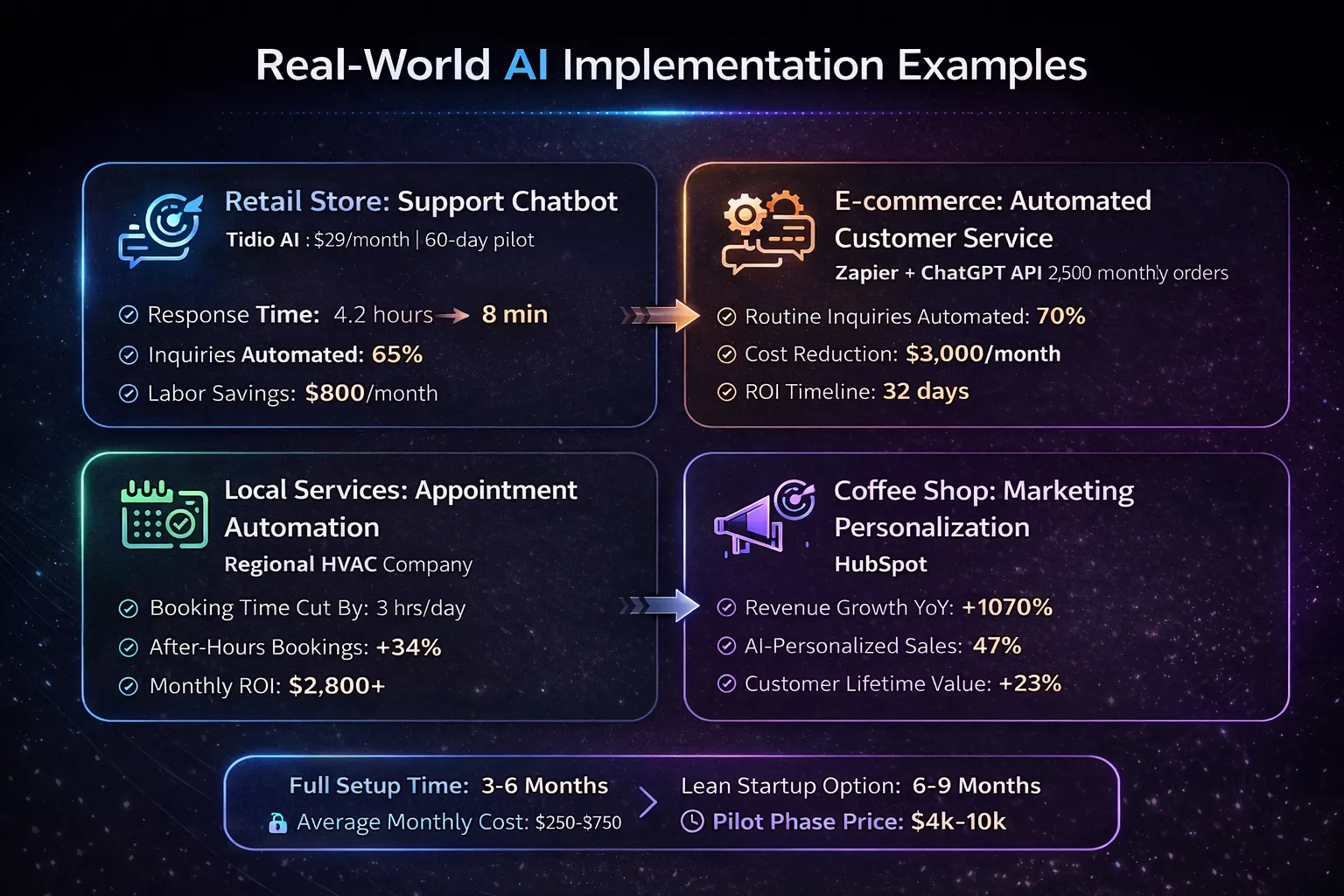
Business: Regional HVAC company (4 technicians) | Tool: AI scheduling assistant integrated with existing CRM
Before: Office manager spent 3 hours daily on scheduling, rescheduling, and confirmation calls. After-hours calls went to voicemail and were lost to faster competitors.
After: 78% of booking requests handled automatically, including after-hours. Office manager's scheduling time dropped to under 45 minutes daily.
46% cite skills gaps as primary barriers. Untrained teams don't adopt tools consistently.
Solution: Budget 2–4 hours per employee. Create reference guides. Celebrate early wins publicly.
The 70–85% failure rate stems from lack of clear strategy, absence of ROI measurement, failure to redesign workflows, and inadequate training. These are execution failures, not technology failures.
AI is no longer optional for small businesses seeking competitive advantage. The question is not whether to adopt—it's how to implement strategically for measurable returns rather than expensive experimentation.
The gap between the 8.8% achieving full integration and the majority experimenting is significant—and growing. A business that implements AI effectively in year one doesn't just gain an efficiency advantage. It generates better data, refines processes faster, and develops internal expertise that accelerates every subsequent implementation.
By year three, a well-implemented AI strategy creates operational capabilities that a late adopter would take years to replicate—even if they started immediately. Early movers aren't just ahead. They're building structural advantages that widen every quarter.
The competitive dynamic is also reshaping what customers expect. Businesses receiving instant, accurate, personalized responses from AI-enabled competitors increasingly interpret slower responses not as normal practice—but as poor service.
Response time expectations, content quality baselines, and personalization standards are being reset upward by businesses that have operationalized AI effectively. Competing manually against AI-augmented businesses in customer-facing functions becomes progressively harder regardless of product or pricing advantages.
According to Salesforce's State of the Connected Customer report, 80% of customers now consider the experience a company provides to be as important as its products or services—making AI-powered responsiveness a direct revenue driver, not just an operational efficiency.
For small businesses specifically, AI narrows the operational gap between small and large competitors more than any previous technology. A four-person service business with properly implemented AI can deliver response times, marketing sophistication, and customer experience consistency that previously required teams ten times larger.
That capability is available now—but only to businesses willing to implement with discipline.
Start with measurable outcomes, not technology fascination
Identify high-impact use cases through structured analysis
Redesign workflows before implementing tools
Run controlled pilots with defined metrics
Measure ROI rigorously from day one
Expand gradually after proving value
Maintain human oversight on high-stakes decisions
Your biggest risk isn't choosing the wrong tool—it's having no implementation strategy. Your biggest opportunity isn't buying more subscriptions—it's operationalizing AI deeply into core workflows where it generates compounding returns.
The businesses implementing AI strategically today are building moats their competitors will spend years trying to cross.
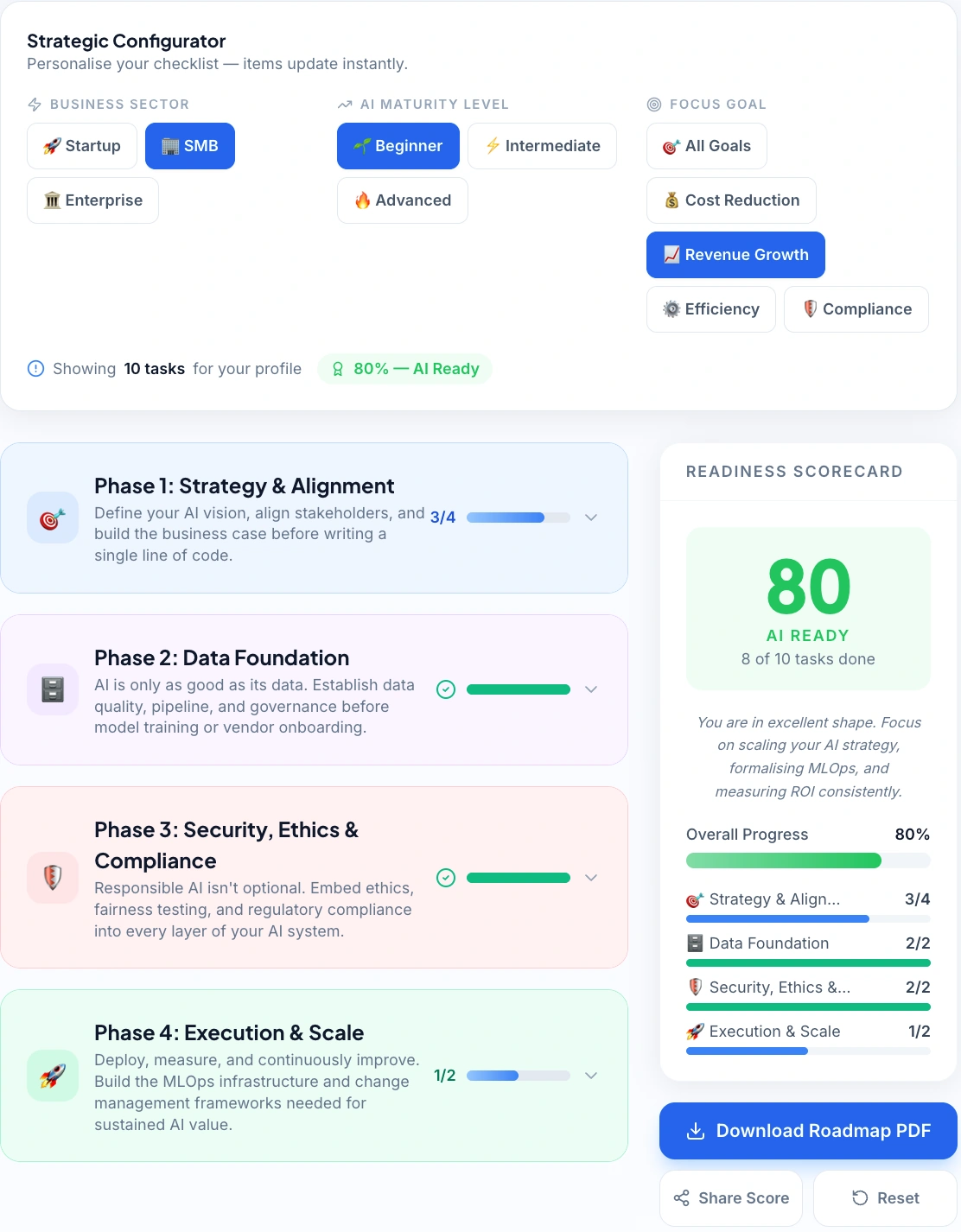
AI Implementation Checklist
Free Tool
Build Your AI Rollout Plan in Minutes
Our step-by-step checklist generates a tailored AI implementation roadmap for your business—covering pilot structure, KPIs, and expansion strategy.
Most SMBs spend $100–$500 monthly on subscriptions with $2,500–$5,000 one-time setup costs. Lean implementations start at $20–$100 monthly with no setup costs but extend timelines from 3–6 months to 6–9 months. The most important cost consideration isn't the tool subscription—it's internal labor for workflow redesign, training, and measurement. Underestimating implementation time is the most common budgeting mistake small businesses make.
Structured implementation takes 3–6 months from planning to full deployment. Pilots launch within 30–60 days. Businesses compressing timelines to 30 days encounter the 70–85% failure rate. Teams that rush to show results quickly skip documentation and measurement steps—producing short-term activity with no long-term compounding benefit.
Industry research shows average returns of $3.70 per dollar invested, with high performers seeing 26–55% productivity improvements and 15–25% revenue increases. These returns require proper implementation, measurement, and workflow integration. Businesses that measure rigorously almost always find their ROI exceeds initial projections because measurement reveals improvement opportunities that would otherwise remain invisible.
The 70–85% failure rate stems from lack of clear strategy, absence of ROI measurement, failure to redesign workflows, and inadequate training. These are execution failures, not technology failures. Businesses that fail typically spent more time evaluating and purchasing tools than planning how their workflows would change—a sequence that virtually guarantees poor results.
Highest ROI areas include customer support automation (60–70% inquiries automated), marketing content creation (15–20 hours saved monthly), email personalization (12–18% conversion improvement), sales optimization (25–30% more selling time), and workflow automation (10–15 hours saved weekly). The best starting point is whichever area represents your single largest time cost per week.
AI functions best as augmentation, not replacement. It handles repetitive pattern recognition, data processing, and routine responses—freeing employees for judgment, relationships, and strategy. Businesses framing AI as headcount reduction encounter significant resistance. Businesses framing it as eliminating tedious work to focus on meaningful tasks see faster, more enthusiastic adoption.
AI should assist but not make final decisions in legal interpretation, compliance, financial approvals, or hiring. Use AI to research, prepare information, and draft recommendations—but require qualified human review for all final decisions. One wrong AI decision can cost more than years of accumulated benefits.
Research shows 46% report skills gaps as the primary barrier—manifesting as employees not trusting outputs, lacking prompt knowledge, using tools inconsistently, and resisting workflow changes. The most underestimated training element isn't technical skill—it's building judgment to know when AI outputs are reliable and when they require correction. That calibration develops through supervised practice, not tool tutorials alone.
AI implementation is no longer about experimenting with tools—it's about building systems that generate measurable business results.
Small businesses that succeed with AI follow a disciplined approach: they start with clear outcomes, select high-impact use cases, redesign workflows before introducing tools, and measure ROI at every stage. This structured execution is what separates the 8.8% of businesses achieving full AI integration from the majority that struggle to see results.
The opportunity is significant. AI can reduce operational costs, unlock new revenue streams, and dramatically improve customer experience—but only when implemented strategically.
If you're just starting, don't overcomplicate it:
Focus on one workflow.
Run a controlled pilot.
Prove ROI before scaling.
The businesses that win with AI in 2026 won’t be the ones using the most tools—they’ll be the ones using AI with the most discipline.
Start this week, not next quarter. The gap between leaders and followers grows wider every month.
The ROI-first framework for small business owners and marketers. Curated AI email tool comparison, budget stack templates, and a 60-day implementation plan for solo operators, growing teams, and e-commerce brands.