Why AI Is Becoming Mandatory for E-commerce in 2026
The e-commerce economics that worked in 2021 don't work in 2026. Customer acquisition costs have risen 60% over four years across major paid channels, per Profitwell research. Inventory carrying costs are up. Contribution margins are compressed. Stores that relied on volume growth to paper over operational inefficiency are facing their first real margin crisis.
Against this backdrop, AI has graduated from a feature to a structural necessity. According to Salesforce's State of Commerce report, 77% of high-performing e-commerce teams now use AI daily for core revenue functions: personalization, support automation, and predictive replenishment. IDC projects AI-driven e-commerce software spending to exceed $8 billion globally by 2026. The most consequential shift is toward agentic commerce — AI systems that autonomously execute tasks including pricing adjustments, replenishment orders, and re-engagement campaigns without human initiation.
For Shopify and WooCommerce operators, the question isn't whether to adopt AI tools. It's which ones move the metrics that matter, and in what sequence.
For a broader framework on AI software selection, see: Complete Guide to Choosing AI Software for Your Business (2026 Edition).
→ Not sure if this ROI applies to your store? Try the AI ROI Calculator to model your real numbers based on traffic, conversion rate, and AOV.
- High-performer adoption: 77% of high-performing e-commerce teams now use AI daily for personalization, support automation, and predictive replenishment, per Salesforce's State of Commerce report.
- Market size: IDC projects AI-driven e-commerce software spending to exceed $8 billion globally by 2026.
- Acquisition cost pressure: Customer acquisition costs have risen 60% over four years across major paid channels, per Profitwell research.
- Cart abandonment: The Baymard Institute puts average cart abandonment at 70.19% — the single highest-ROI automation opportunity at every store size.
Where E-commerce Stores Actually Lose Revenue
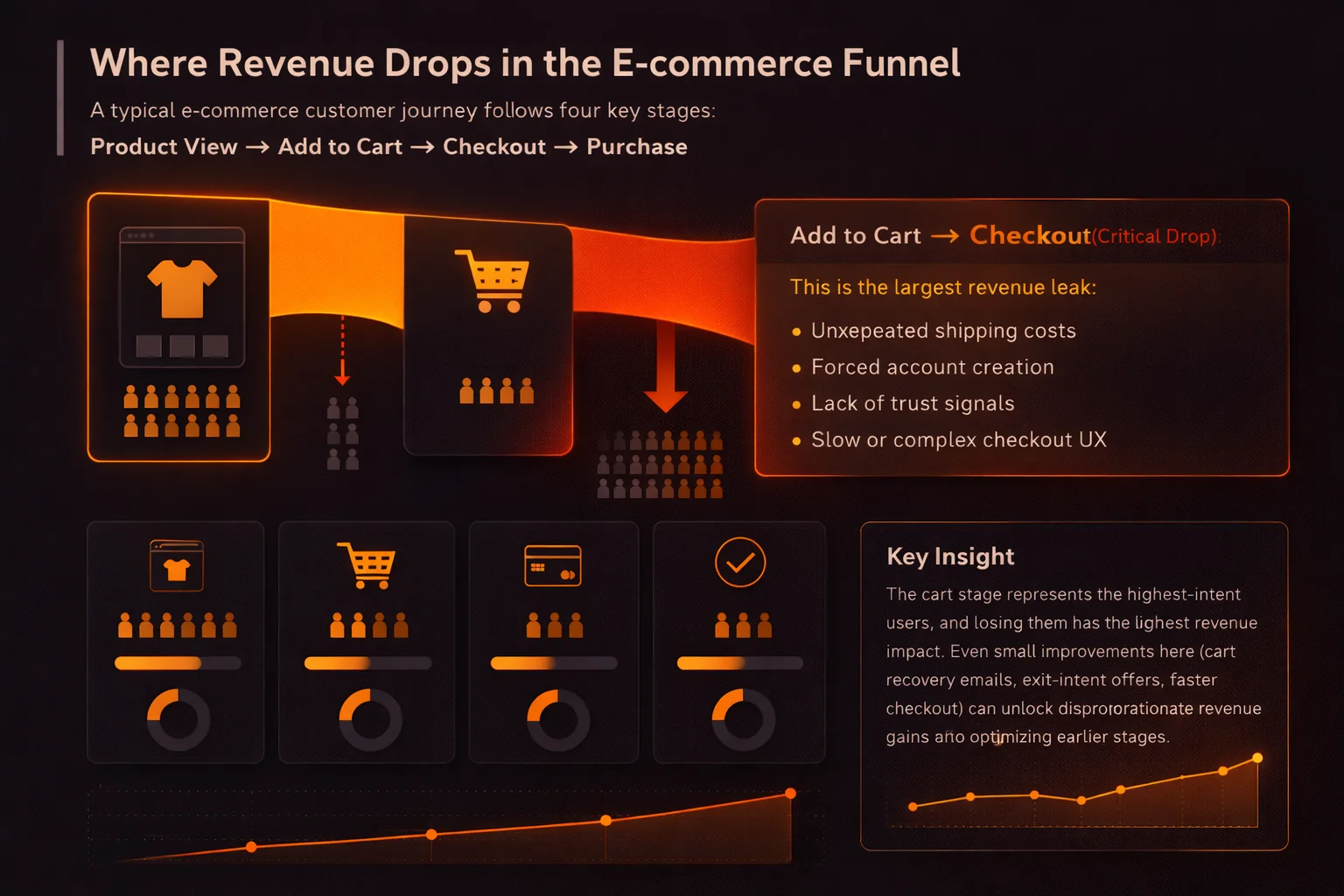
Visualizing the e-commerce customer journey and the critical revenue leaks during the checkout phase.
Before selecting any tool, identify exactly where the bleeding happens. Five bottlenecks account for most unrealized e-commerce revenue:
1. Cart Abandonment (~70%) The Baymard Institute's aggregate data across 50+ studies puts average cart abandonment at 70.19%. For a store doing $50K/month with a 2% conversion rate, recovering even 10% of abandoned carts at $75 AOV represents $5,250/month in revenue currently left on the table. This is the single highest-ROI automation opportunity at every store size.
2. Weak Product Recommendations McKinsey attributes 35% of Amazon's revenue to its recommendation engine. Most mid-market DTC stores run static 'customers also bought' logic. Conservative modeling suggests 8–12% of potential AOV lift is unrealized by stores without dynamic recommendations — $9,600–14,400/month on a $120K/month store.
3. Slow or Expensive Customer Support Gartner data from 2025 indicates brands resolving support queries within one hour retain customers at a 25% higher rate than those responding in 24+ hours. At $8–15 per ticket (Zendesk benchmarks), a store handling 400 tickets/month spends $3,200–6,000 on support labor — 70–80% of which involves routine queries AI answers automatically.
4. Poor Lifecycle Email Sequences Klaviyo's internal data shows triggered flows generate 3–4x the revenue per email of broadcast campaigns. A store with 10,000 subscribers and no win-back sequence loses an estimated $500–1,200/month in recoverable repeat purchase revenue. Most stores below $200K/month have fewer than three active flows.
5. Inventory Mis-Forecasting Excess inventory erodes margin through discounting. Stockouts lose sales and damage retention. For $100K+/month stores, inventory mis-forecasting costs an estimated 4–8% of revenue annually in combined carrying costs and lost sales — $4,800–9,600/year for a $100K/month store — preventable with AI demand forecasting.
Cart recovery is the highest-ROI automation at every store size — deploy it first, before any other AI investment. A three-message abandoned cart sequence in Klaviyo (email at 1 hour, email at 24 hours, SMS at 48 hours) typically shows measurable results within 7–14 days.