All tools reflect official starting plan pricing. B2B use cases and ICP-targeting capabilities are prioritized.
→ Not sure which tool fits your current funnel stage? Use our AI Lead Gen Tool Selector to get a personalized recommendation based on your sales model and monthly lead target.
HubSpot#
Best for: All-in-one inbound lead generation and CRM pipeline management
HubSpot is the default starting point for most B2B businesses managing inbound leads. Its free CRM covers contact management, deal pipeline, email sequences, and basic lead scoring — making it genuinely useful before you spend anything. The AI-powered lead scoring feature assigns contact scores based on behavioral signals: page visits, email opens, content downloads, and form submissions. This means your sales team works the highest-intent leads first, not the most recent ones.
For SaaS companies and agencies running content-driven inbound funnels, HubSpot's integration between marketing automation and CRM eliminates the handoff friction that typically causes leads to fall through the gap between marketing and sales.
Key AI Features:
- Predictive lead scoring — ranks contacts by conversion probability based on behavioral data
- AI email sequence suggestions — recommends follow-up timing and content based on contact engagement
- Chatbot builder — qualifies inbound leads from website automatically
- Smart content — personalizes website and email content based on contact properties
Pricing: Free CRM (full features), $20/month (Starter), $890/month (Professional — full marketing automation)
Pros: Most complete inbound lead management system available. Free CRM is genuinely powerful before any paid upgrade. Strong integration ecosystem (Salesforce, Slack, Gmail, 1,000+ apps).
Cons: Full Marketing Hub automation requires the Professional plan at $890/month — a significant jump from Starter. Reporting depth on lower tiers is limited. Less useful for pure outbound prospecting — pair with Apollo.io for outbound workflows.
Apollo.io#
Best for: Outbound B2B prospecting — finding and reaching ICP-matched contacts at scale
Apollo.io is the most complete outbound lead generation platform on this list. Its contact database covers 275+ million contacts with AI-powered ICP filtering: you define your ideal customer by industry, company size, job title, technology stack, funding stage, and growth signals — and Apollo returns a targeted list in seconds. The built-in sequencing tool automates multi-step outreach across email and LinkedIn without requiring a separate tool.
The AI personalization feature generates first-line personalizations for cold emails based on each contact's LinkedIn activity, recent company news, and role-specific context — which is the primary driver of the response rate improvements Apollo users report.
Key AI Features:
- AI contact search — ICP filtering across 275M+ contacts with 65+ data attributes
- AI-generated email personalizations — first-line personalization based on contact context
- Sequence automation — multi-step email + LinkedIn outreach with AI timing optimization
- Intent signals — surfaces contacts actively researching solutions in your category
Pricing: Free (limited credits), $59/month (Basic), $99/month (Professional — full sequencing)
Pros: Best outbound prospecting tool for B2B teams at any budget. Free tier is genuinely useful for validation. Strong contact data quality for US-based companies. Built-in sequencing eliminates the need for a separate outreach tool.
Cons: Credit-based contact export system can constrain high-volume prospecting on entry plans. Data quality varies by geography — strongest for North America, weaker internationally. Email deliverability depends on your domain reputation, not Apollo's infrastructure.
ZoomInfo#
Best for: Enterprise-level B2B data — deepest contact and company intelligence available
ZoomInfo is the most data-rich B2B platform on this list. Where Apollo.io excels at outreach workflow, ZoomInfo leads on data depth: intent signals, technographic data, org chart mapping, and real-time job change alerts give enterprise sales teams a level of account intelligence that lower-cost tools can't match.
The Intent feature identifies companies actively researching topics related to your product — surfacing buying signals before a prospect fills out a form or responds to an email. For enterprise sales teams with longer cycles and higher deal values, this pre-intent identification can compress the discovery phase significantly.
Key AI Features:
- Intent data — identifies companies showing active research behavior in your category
- AI ICP matching — scores accounts against your defined ideal customer profile
- Org chart mapping — identifies decision-makers and reporting structures within target accounts
- Job change alerts — notifies when a contact you're tracking changes roles
Pricing: Custom pricing (typically $15,000–$40,000/year for team plans)
Pros: The deepest B2B data platform available. Intent signals are a genuine competitive advantage for enterprise teams with the budget to act on them. Strong CRM integrations with Salesforce and HubSpot.
Cons: Price point is inaccessible for SMBs and early-stage companies. Requires a dedicated ops resource to get full value from the platform. Apollo.io covers 80% of ZoomInfo's use cases for SMBs at 10% of the cost.
Clearbit#
Best for: Lead enrichment — turning anonymous visitors and partial contacts into full profiles
Clearbit solves a specific problem that most B2B companies don't realize they have: they're already generating leads, but those leads arrive incomplete. A form submission with just a name and email address gives your sales team almost nothing to work with. Clearbit appends company name, size, industry, technology stack, LinkedIn URL, and role information to that contact record in real time — turning a partial lead into a qualified one before it reaches your CRM.
The Reveal feature identifies anonymous website visitors by company — showing you which businesses are browsing your pricing page or case studies without filling out a form. That's pipeline visibility most companies are currently blind to.
Key AI Features:
- Real-time lead enrichment — appends 100+ data attributes to new form submissions automatically
- Reveal — identifies anonymous website visitors by company and intent signal
- Prospector — generates target contact lists within enriched company profiles
- HubSpot and Salesforce native integration
Pricing: Custom pricing (contact Clearbit for current rates — acquired by HubSpot in 2023, pricing varies by plan tier)
Pros: Best-in-class lead enrichment quality. Reveal feature provides pipeline visibility no other tool on this list offers. Native HubSpot integration means enrichment happens inside your existing workflow.
Cons: Custom pricing creates friction for budget-conscious buyers. Less useful as a standalone tool — delivers maximum value when integrated with a CRM and lead scoring system.
Leadfeeder#
Best for: Identifying high-intent website visitors who never fill out a form
Most B2B websites convert 1–3% of visitors into leads. Leadfeeder identifies the other 97% — matching IP addresses to company records and surfacing which businesses visited your site, which pages they viewed, and how long they spent there. For outbound sales teams, this is a warm lead list that requires no cold outreach — these companies are already aware of you.
The AI scoring feature prioritizes visitors by intent signals: companies that viewed your pricing page and case studies twice in 48 hours are scored higher than companies that bounced from the homepage. That prioritization is what separates Leadfeeder from raw analytics data.
Key AI Features:
- Visitor-to-company matching — identifies companies from anonymous IP traffic
- Intent scoring — ranks visitor companies by page behavior and visit frequency
- CRM integration — pushes identified companies to HubSpot or Salesforce as new leads
- Slack alerts — notifies sales reps in real time when target accounts visit key pages
Pricing: Free (5 leads/week, 7-day history), $99/month (Paid — unlimited leads and history)
Pros: Surfaces warm pipeline from traffic you're already generating. Intent scoring makes prioritization straightforward. Strong HubSpot and Salesforce integration.
Cons: Requires meaningful website traffic to be useful — less valuable for sites under 500 monthly visitors. Company matching accuracy varies (IP-based identification has inherent limitations). Doesn't provide individual contact details — pair with Apollo.io to find the right person at identified companies.
Drift#
Best for: Conversational AI — capturing and qualifying high-intent leads from website traffic in real time
Drift's AI chatbot engages website visitors at the moment of highest intent — when they're actively on your pricing page, reading a case study, or considering a demo request. Instead of routing visitors to a form that creates a 24-hour response lag, Drift qualifies them conversationally and books meetings directly into your sales reps' calendars.
For SaaS companies and B2B businesses where demo booking rate is the primary pipeline metric, Drift's ability to compress the time between "interested visitor" and "scheduled meeting" to under 5 minutes is a measurable conversion improvement.
Key AI Features:
- Conversational AI chatbot — qualifies leads through natural conversation, not form fields
- AI meeting booking — schedules demos directly from chat without human rep involvement
- Account-based marketing routing — serves different chat experiences to target accounts versus general traffic
- Revenue acceleration — prioritizes live chat engagement for high-value target accounts
Pricing: $2,500/month (Premium) — significant investment relative to other tools on this list
Pros: Best tool for converting high-intent website traffic into booked meetings. Conversational qualification produces more complete lead data than form submissions. Meeting booking automation removes friction from the demo request process.
Cons: Price point is inaccessible for most SMBs. Full AI features require the Premium plan. Less useful for outbound prospecting — purely a conversion and capture tool for inbound traffic.
ChatGPT#
Best for: Personalized outreach copy and AI-assisted prospecting research
ChatGPT is different from every other tool on this list — it's not a lead database or a CRM. It's a flexible AI system that dramatically improves the quality of your outreach at zero marginal cost per email. The core use case is personalization: feeding ChatGPT a prospect's LinkedIn profile, recent company news, and role context, then generating a cold email first line or entire sequence that feels genuinely researched rather than templated.
Used alongside Apollo.io for contact identification, ChatGPT completes the outbound workflow for under $80/month — the most cost-effective outbound stack on this list.
Key AI Features:
- Personalized cold email generation — first lines and full sequences from prospect context
- ICP definition assistance — helps refine your ideal customer profile with structured prompts
- Objection handling scripts — generates responses to common sales objections by persona
- Research summarization — condenses prospect company news into outreach-relevant talking points
Pricing: Free (GPT-4o limited), $20/month (Plus — full access)
Pros: Most flexible and cost-effective personalization tool available. Dramatically improves cold email quality without adding per-contact cost. Works alongside any existing lead generation stack.
Cons: Requires prompt skill to get consistently strong output — there's a learning curve. Not a lead database — can't identify prospects on its own. Output requires human review for accuracy and brand voice consistency.
Mini Case Study: How a SaaS Company Increased Demo Bookings by 47% Using Apollo + AI Personalization#
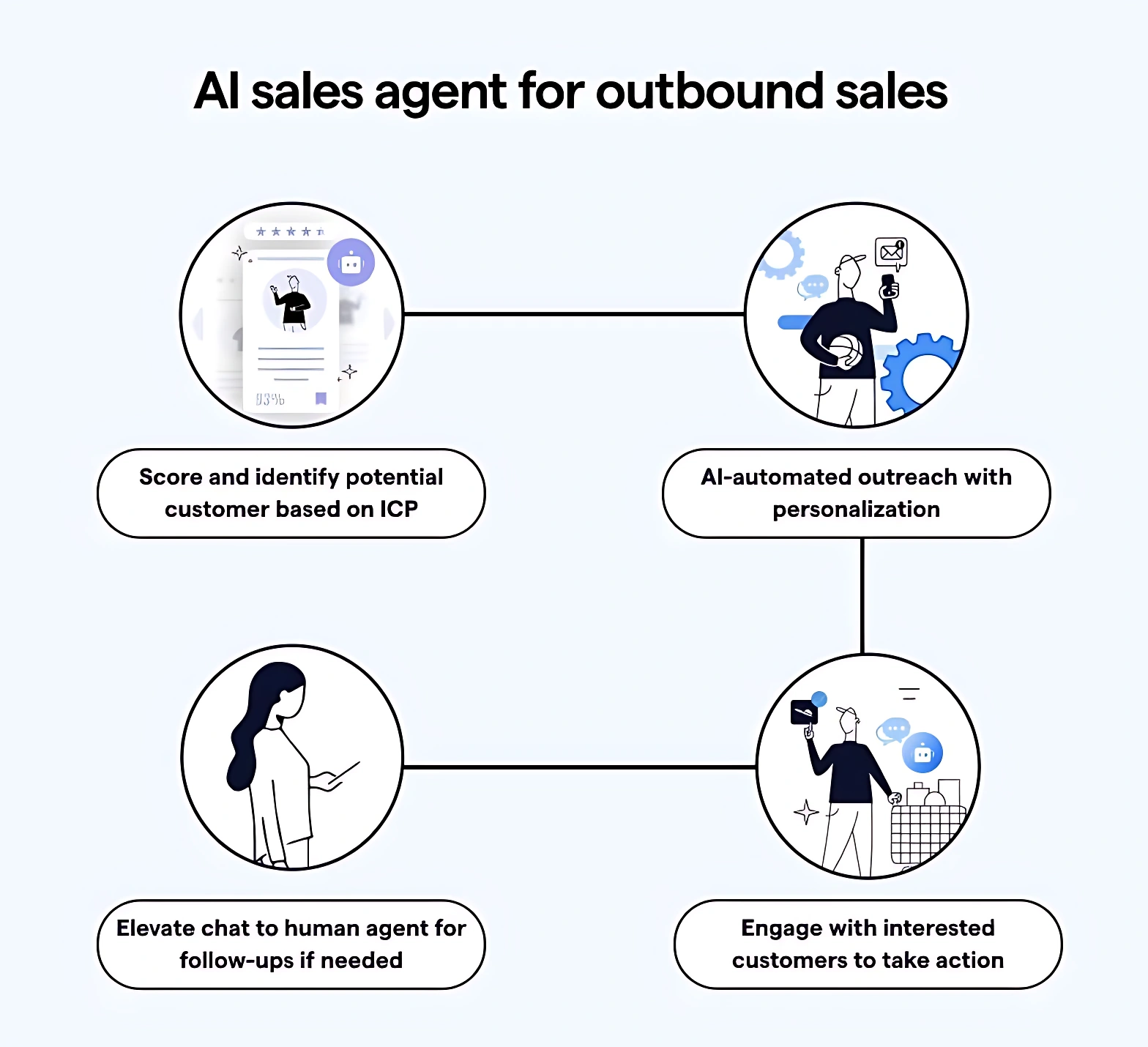
The AI Outbound Workflow: Leveraging AI agents to score potential customers based on Ideal Customer Profiles (ICP) and automate personalized engagement at scale.
Company: B2B project management SaaS, 12-person team, targeting operations managers at companies with 50–500 employees
Problem: SDR team was sending 150 cold emails per week with a 1.8% reply rate. Demo bookings had plateaued at 8–10 per month despite increasing outreach volume. Cost per booked demo was $340.
Stack deployed: Apollo.io Professional ($99/month) + ChatGPT Plus ($20/month)
What they changed:
The team had been using generic templates — the same email body sent to every contact with only the first name swapped. Apollo's AI personalization feature and ChatGPT together enabled a different approach.
For each outreach batch, the SDR pulled 30 ICP-matched contacts from Apollo and used the following ChatGPT prompt for each:
"Write a 3-sentence cold email opening for a SaaS outreach to [Name], [Title] at [Company]. They recently [relevant company news or LinkedIn activity]. Our product helps operations teams reduce project handoff delays. Make it specific to their context, not generic."
Before AI personalization:
Subject: Improve your team's project management

Hi [First Name],

I wanted to reach out because we help operations teams like yours
reduce project delays and improve cross-team visibility.

Would you be open to a 20-minute call to see if we might be a fit?

Best,
[SDR Name]
After AI personalization (ChatGPT + Apollo context):
Subject: Saw your post about the Q1 rollout challenges

Hi Sarah,

Noticed your LinkedIn post last week about the communication gaps
during your Q1 product rollout — that's exactly the kind of
cross-team handoff problem our platform was built to eliminate.

Companies like Notion and Loom used the same approach you're
describing before switching to a structured handoff system —
and cut their average project delay from 11 days to 3.

Worth a 20-minute look?

[SDR Name]
Results after 60 days:
- Reply rate: 1.8% → 5.3% (+194% relative improvement)
- Demo bookings: 9/month → 15/month (+67%)
- Cost per booked demo: $340 → $148 (−56%)
- Total stack cost increase: $119/month
The key insight: The personalization didn't require more time — it required a different workflow. Each personalized email took 4 minutes instead of 30 seconds. But at a 3x higher reply rate, the time investment per booked demo dropped significantly. The AI didn't replace the SDR; it gave the SDR enough context to send emails that felt like they came from a person who had done their homework.