All pricing reflects current starter plan costs in USD. Free tier availability is noted where applicable.
1. HubSpot Sales Hub#
HubSpot is the closest thing to an all-in-one sales platform that small businesses can actually afford. The free CRM alone is more capable than most paid tools, and when you add Sales Hub on top, you get AI-powered email sequences, deal tracking, meeting scheduling, and pipeline forecasting in one place.
What makes it stand out for small businesses is how little setup it requires. You don't need a developer or a consultant. Most teams are up and running within a day or two — and the learning curve is gentle enough that even non-technical founders can use it confidently.
Key Features:
- AI email personalization and sequences
- Lead scoring and deal stage predictions
- Meeting scheduling (no back-and-forth emails)
- Sales pipeline dashboard with AI forecasting
- 1,000+ integrations via the HubSpot ecosystem
Pricing (USD):
- Free CRM: $0 (genuinely useful, not just a trial)
- Starter: $20/month
- Professional: $100/month
- Enterprise: $150/month per user
Pros:
- Best free tier in the CRM category
- Intuitive interface — no training needed
- Scales well as your team grows
- Strong documentation and support community
Cons:
- Advanced features require paid plans
- Can get expensive at the Professional tier and above
Best For: Small businesses that want a full CRM + sales automation platform without hiring a dedicated admin to run it.
2. Apollo.io#
If lead generation is your bottleneck, Apollo.io is one of the most powerful tools you can add to your stack. It gives you access to a database of over 275 million contacts, combined with AI-driven outreach sequences that can be personalized at scale.
For small businesses doing outbound sales, Apollo removes the most time-consuming part of the process: finding the right people to contact. You can filter by industry, company size, role, location, and a dozen other signals — then launch an automated email sequence directly from the platform.
Key Features:
- 275M+ verified contact database
- AI-powered email sequencing and follow-ups
- LinkedIn integration for multi-channel outreach
- Lead scoring based on intent signals
- Built-in dialer for cold calling
Pricing (USD):
- Free: Limited credits (good for testing)
- Basic: $49/month per user
- Professional: $99/month per user
- Organization: Custom pricing
Pros:
- Massive, regularly updated contact database
- Strong outbound automation in one tool
- Generous free tier to start with
Cons:
- Data quality varies by industry/region
- The interface can feel dense for first-time users
Best For: Small businesses doing outbound prospecting who need both contact data and automated outreach in a single platform.
3. Saleshandy#
Saleshandy is what you choose when you want serious email outreach capability without a serious price tag. It's purpose-built for cold email — handling everything from deliverability warm-up to automated follow-up sequences with A/B testing built in.
For bootstrapped teams or solopreneurs running outbound sales, it's hard to beat at this price point. The AI-powered writing suggestions help improve email copy, and the deliverability features ensure your emails actually land in inboxes rather than spam folders.
Key Features:
- AI cold email personalization
- Automated multi-step follow-up sequences
- Email warm-up to improve deliverability
- A/B testing across subject lines and body copy
- Detailed open/click/reply analytics
Pricing (USD):
- Free trial available
- Outreach Starter: $25/month
- Outreach Pro: $74/month
- Agency plans available
Pros:
- Very affordable for what it delivers
- Strong focus on email deliverability
- Easy to set up without technical knowledge
Cons:
- Focused on email only — not a full CRM
- Limited integrations compared to larger platforms
Best For: Solopreneurs and small sales teams running cold email campaigns on a tight budget.
4. Fireflies.ai#
Every sales call contains valuable information. Fireflies.ai makes sure you never lose any of it. It automatically joins your Zoom, Google Meet, or Teams calls, records and transcribes everything, then generates a clean summary with action items — ready before you've even closed your laptop.
For small business owners who wear multiple hats, this is one of the highest-ROI tools on this list. No more re-listening to recordings. No more missed follow-ups because you forgot to write something down. Fireflies handles all of it automatically.
Key Features:
- Automatic call recording and AI transcription
- Meeting summaries with action items
- Integrates with Zoom, Teams, Meet, and more
- CRM sync (pushes notes directly to HubSpot, Salesforce, etc.)
- Keyword tracking and searchable call archive
Pricing (USD):
- Free: Limited transcription credits
- Pro: $10/month per user
- Business: $19/month per user
- Enterprise: Custom pricing
Pros:
- Saves significant time on post-call admin
- Accurate transcription even with accents
- Seamless CRM integration
Cons:
- Free plan has storage limits
- Some users prefer manual note-taking for sensitive conversations
Best For: Any small business owner or sales rep who spends time on discovery calls, demos, or client check-ins and wants to eliminate manual note-taking entirely.
5. Lavender#
Lavender is an AI email coach that works inside your inbox — Gmail or Outlook — and tells you, in real time, how to improve the email you're writing. It scores your email as you type, flags issues, suggests shorter sentences, and even personalizes intros using LinkedIn data about the recipient.
It's a simple concept that produces noticeable results. Teams using Lavender consistently report higher reply rates — and it's easy to understand why. Most sales emails are too long, too vague, or too focused on the sender. Lavender nudges you toward emails that actually get responses.
Key Features:
- Real-time email scoring as you write
- AI personalization using LinkedIn and company data
- Mobile optimization check (since most emails are read on phones)
- Reply rate benchmarking against similar senders
- Works inside Gmail and Outlook natively
Pricing (USD):
- Free: 5 emails/month
- Starter: $27/month per user
- Individual: $29/month per user
- Team plans available
Pros:
- Improves email quality without leaving your inbox
- Fast learning curve
- Measurable impact on reply rates
Cons:
- Limited to email — doesn't cover other channels
- Best value is in team plans
Best For: Sales reps and founders who want to write better cold and follow-up emails without hiring a copywriter.
6. Gong.io#
Gong.io is revenue intelligence. It records and analyzes every sales conversation — calls, emails, video meetings — and surfaces patterns that tell you what your best reps do differently, what objections come up most often, and which deals are at risk.
For small businesses with a sales team (even a small one), Gong can change how you coach, how you forecast, and how you understand your pipeline. The AI surfaces insights you'd never find manually — like the fact that deals where competitors are mentioned in the first call close 23% less often.
Key Features:
- AI analysis of calls, emails, and meetings
- Deal risk alerts and pipeline forecasting
- Competitor and objection tracking
- Sales coaching tools with side-by-side rep comparisons
- CRM sync and integrations
Pricing (USD):
- Custom pricing (typically $100–$200/user/month)
- Free demo available
Pros:
- Genuinely deep sales intelligence
- Helps replicate what your best reps do
- Strong ROI for teams with 5+ reps
Cons:
- Expensive for very small teams (1–2 reps)
- Requires some onboarding time to get full value
Best For: Small businesses with a dedicated sales team who want to improve performance through data rather than guesswork.
7. Nimble CRM#
Nimble is a lightweight CRM built specifically for small businesses and solopreneurs. It pulls contact information automatically from email, social media, and calendar data — so your CRM stays updated without manual entry. The AI then helps you identify who to follow up with and when.
If you've tried bigger CRMs and felt overwhelmed, Nimble is worth a look. It does less, but it does the important things cleanly — and it's genuinely easy to use.
Key Features:
- Auto-enriched contact profiles from email and social
- AI-powered follow-up reminders and activity suggestions
- Pipeline management with deal tracking
- Group messaging and email sequences
- Browser extension for quick contact capture
Pricing (USD):
- Nimble: $24.90/month per user (monthly billing)
- Discounts available on annual plans
Pros:
- Very easy to learn and maintain
- Excellent contact enrichment — minimal manual entry
- Works well for individuals and small teams
Cons:
- Lighter on advanced automation than HubSpot
- Limited reporting depth
Best For: Solopreneurs and small teams who want a low-maintenance CRM they'll actually keep updated.
8. Tidio#
Tidio turns your website into a 24/7 sales assistant. Its AI chatbot — Lyro — engages visitors, answers product questions, qualifies leads, and books meetings — all without any human involvement. For small businesses, this means your website is selling even when you're asleep.
The setup is remarkably fast. Most businesses are live within a few hours. And the Lyro AI handles the majority of common questions without needing constant updates or training.
Key Features:
- Lyro AI chatbot for automated lead qualification
- Live chat for when human support is needed
- Email and Messenger integration
- Pre-built playbooks for sales and support flows
- Analytics on conversation performance
Pricing (USD):
- Free: 50 conversations/month
- Starter: $29/month
- Growth: $59/month
- Tidio+: Custom pricing
Pros:
- Fast setup — no developer needed
- Genuinely capable AI chatbot
- Great free tier to start with
Cons:
- Lyro conversation limits on lower plans
- Customization options are somewhat limited on Starter
Best For: Small businesses and e-commerce stores that get consistent website traffic and want to capture and qualify leads automatically.
9. Cirrus Insight#
Cirrus Insight bridges the gap between Gmail and Salesforce — a gap that costs sales teams hours every week. It lives inside your Gmail inbox and lets you view, update, and log Salesforce data without ever switching tabs. The AI layer adds email tracking, follow-up reminders, and meeting scheduling on top.
For small businesses that are already on Salesforce and living in their inbox, Cirrus is a logical addition.
Key Features:
- Salesforce CRM sync directly from Gmail
- Email open and click tracking
- Automated follow-up reminders
- Meeting scheduling with calendar sync
- Salesforce data entry without leaving Gmail
Pricing (USD):
- Salesforce Sync: $10/month per user
- Pro: $21/month per user
- Expert: $29/month per user
Pros:
- Saves significant time for Salesforce + Gmail users
- Clean, minimal interface
- Strong email tracking features
Cons:
- Only works with Salesforce (not other CRMs)
- Less useful if you don't use Gmail heavily
Best For: Small sales teams using Salesforce who want to manage CRM activity without leaving their inbox.
10. Prospect.io (now Overloop)#
Overloop (formerly Prospect.io) is a sales engagement platform that combines prospecting, email automation, and CRM features in a single interface. It's designed for B2B teams that need to find contacts, reach out at scale, and track every interaction without juggling multiple tools.
Key Features:
- Email finder and contact database
- Multi-channel outreach (email, LinkedIn, phone)
- Automated cadences with AI-driven personalization
- Pipeline management and deal tracking
- Team collaboration features
Pricing (USD):
- Starts at approximately $40/month per user
- Free trial available
Pros:
- Multi-channel outreach in one tool
- Good balance of prospecting and outreach features
- Clean user interface
Cons:
- Smaller contact database than Apollo
- Some advanced features limited to higher plans
Best For: B2B small businesses that want prospecting and outreach combined without managing two separate tools.
Intercom's Fin is an AI agent that handles customer conversations at the front of your sales and support funnel. It resolves the routine questions (pricing, features, availability) instantly, then routes more complex leads to a human — which means your team spends their time on the conversations that actually move the needle.
For small businesses handling a high volume of inbound inquiries, Fin can reduce repetitive workload significantly.
Key Features:
- AI agent that handles inbound questions automatically
- Instant answers using your product documentation
- Smart handoff to human agents when needed
- Multi-channel support (chat, email, WhatsApp)
- Conversation analytics and reporting
Pricing (USD):
- Essential: $39/month per seat
- Advanced: $99/month per seat
- Fin AI agent pricing: $0.99 per resolution
Pros:
- Handles a large volume of common questions automatically
- Easy to feed your existing documentation
- Strong integration with Intercom's broader suite
Cons:
- Per-resolution pricing can add up at scale
- Full value requires the broader Intercom platform
Best For: Small businesses with a high volume of inbound leads or support questions that are repetitive enough for AI to handle reliably.
12. Dialpad#
Dialpad is a business phone system with an AI brain built in. Every call is transcribed in real time, with AI Recaps summarizing the key points and next steps before you hang up. It also offers live coaching — surfacing suggested talking points mid-call based on what's being discussed.
For small sales teams that do a lot of phone-based selling, Dialpad replaces both your phone system and your post-call admin work in one subscription.
Key Features:
- AI real-time transcription and call summaries
- Live coaching with talking point suggestions
- Built-in business phone, SMS, and video meetings
- CRM integrations (Salesforce, HubSpot, and others)
- Sentiment analysis on calls
Pricing (USD):
- Standard: $23/month per user (annual)
- Pro: $35/month per user
- Enterprise: Custom pricing
Pros:
- Combines phone system and AI coaching in one tool
- Real-time call intelligence is genuinely useful
- Good value compared to standalone transcription tools
Cons:
- Call quality can vary based on internet connection
- Some advanced AI features require higher plans
Best For: Small businesses doing significant phone-based sales who want to eliminate post-call note-taking and improve rep performance over time.
13. Clari#
Clari is a revenue operations platform that uses AI to give sales leaders and founders a clear, accurate view of their pipeline. It predicts which deals will close, identifies risk before it becomes a problem, and helps you stop relying on rep-reported numbers that are often optimistic.
For a small business scaling its sales function, Clari brings discipline and predictability to forecasting that most teams only get after hiring a dedicated RevOps person.
Key Features:
- AI-powered pipeline and revenue forecasting
- Deal risk scoring and early warning signals
- Activity capture from email and calendar
- Rep performance analytics
- CRM integration and data enrichment
Pricing (USD):
- Custom pricing (typically mid-market and above)
- Free demo available
Pros:
- Significantly more accurate forecasting than manual methods
- Helps prioritize deals that actually need attention
- Strong integration with Salesforce and HubSpot
Cons:
- Priced for teams with established pipelines
- Less useful for very early-stage businesses with limited deal volume
Best For: Growing small businesses with a sales team and an active pipeline who need reliable forecasting and deal visibility.
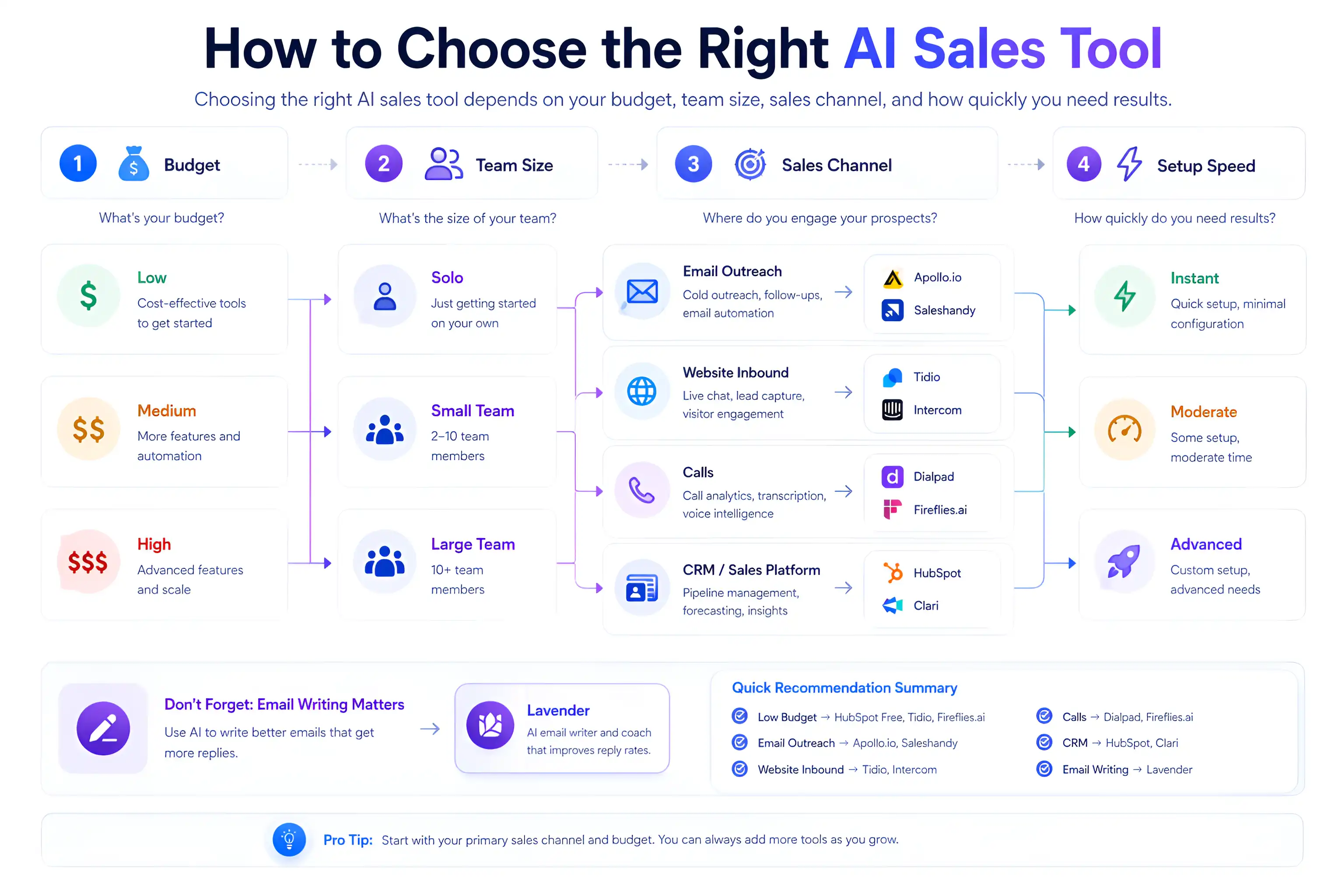
Choosing Your AI Sales Stack: Use this framework to align your automation tools with your specific business budget and primary sales channels for maximum efficiency.
1. What's your budget?
If you're bootstrapped or just starting out, HubSpot's free CRM, Fireflies.ai's free plan, and Tidio's free tier can get you meaningful results before you spend a dollar. Once you're ready to invest, aim for tools that cost less than 10% of the monthly value they generate. Anything more and you should audit your stack.
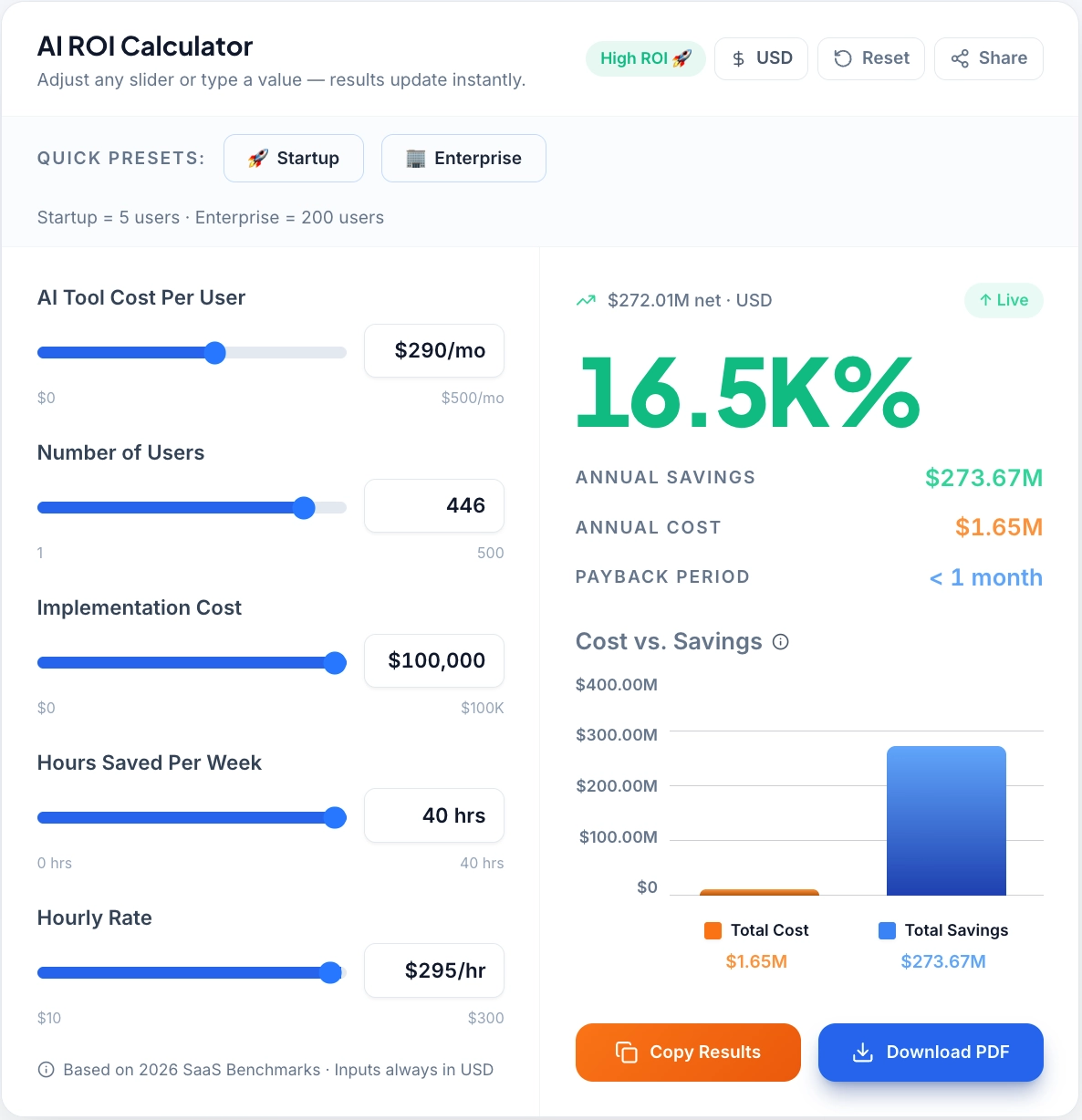
Before committing to paid tools, calculate expected returns using our AI ROI Calculator.
2. How big is your team?
Solo founders do best with tools that are low-maintenance and require minimal setup — Nimble CRM, Saleshandy, or Lavender. Teams of 3–10 benefit more from a proper CRM like HubSpot with shared pipeline visibility. Larger teams can justify Gong or Clari once there's enough deal volume for the AI to work with.
3. What's your primary sales channel?
- Email outreach: Apollo.io or Saleshandy
- Inbound from website: Tidio or Intercom Fin
- Phone calls: Dialpad or Fireflies.ai
- Full pipeline management: HubSpot or Clari
- Writing better emails: Lavender
4. How fast do you need to get started?
If you need something running today, Tidio, Fireflies.ai, and Lavender all deploy in under an hour. HubSpot takes a day or two. Gong and Clari require more onboarding and setup — factor that into your timeline.
💡 Selection Tip
Don't try to implement three tools at once. Pick the one that solves your single biggest bottleneck — whether that's finding leads, following up, or logging calls — and prove ROI on that before adding anything else to your stack.
According to recent research from McKinsey, AI adoption among small and mid-sized businesses has accelerated significantly over the past few years.