Speed is the obvious answer. But the deeper reason is leverage.
💡 Expert Insight: Volume vs. Perfection
In 2026, the real advantage of AI image generation isn't the ability to create one perfect image—it's the ability to produce 50 "good enough" variations for testing.
Marketing performance now follows a data-driven path: generate volume, test across audiences, and double down on what works. Don't let the pursuit of a single pixel-perfect visual stop you from high-frequency testing. Speed to market is the new high-quality.
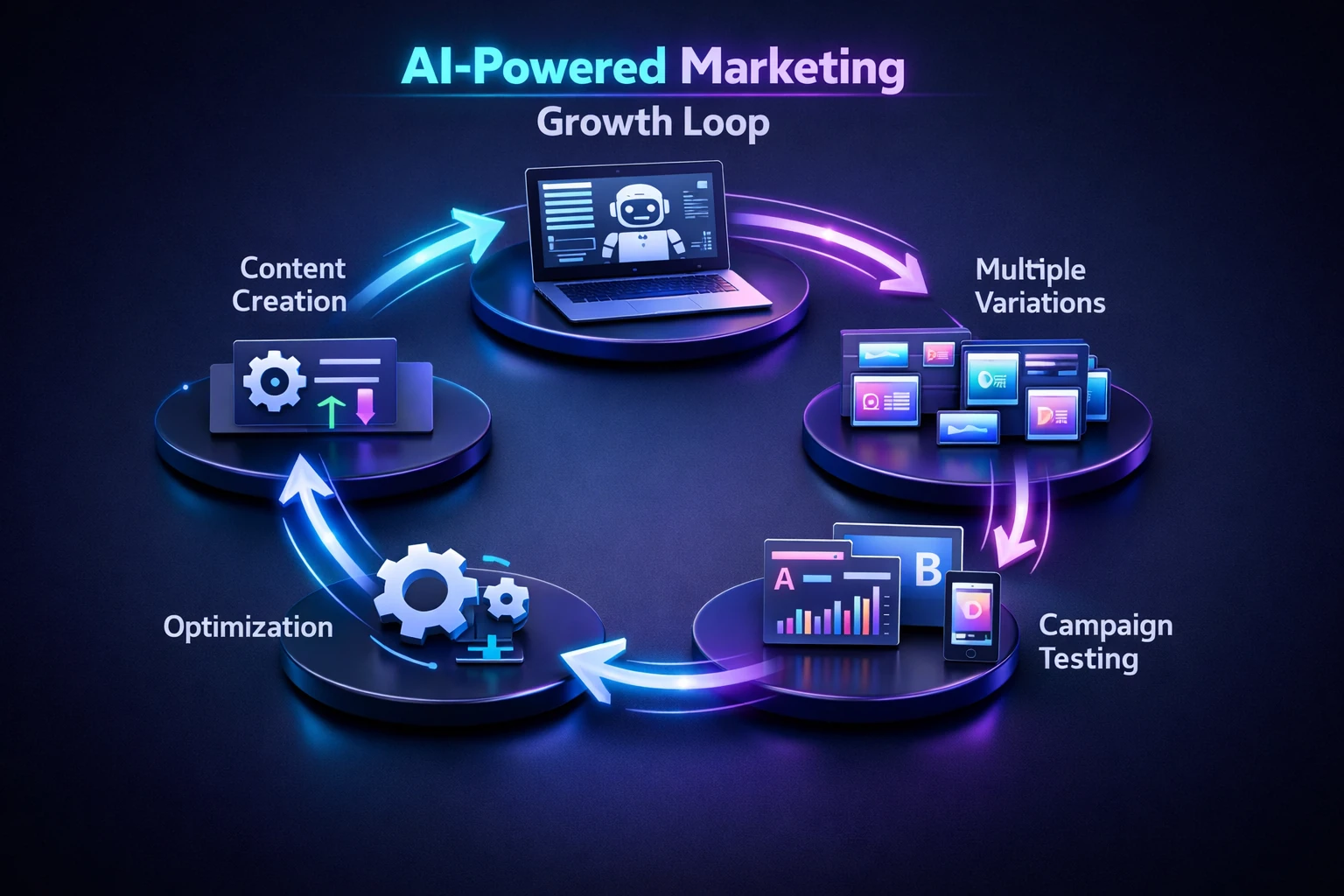
Faster content creation means more campaigns tested, more variations published, and more data collected — all without proportional increases in cost or headcount.
Cost reduction is significant. A single professional product photoshoot can run $1,500–$5,000. AI tools replace that cost entirely for many standard use cases — product mockups, lifestyle backgrounds, social creatives — at a fraction of the price.
Unlimited creative variations change how you approach testing. Instead of committing to one creative direction per campaign, you can generate 10 variations, run them simultaneously, and let performance data tell you what resonates. That's a fundamental upgrade to how paid media works.
Personalization at scale is where it gets powerful. AI tools let you adapt visuals to different audience segments, seasonal contexts, or regional markets — without redesigning from scratch each time. What used to require a full design sprint now takes an afternoon.
The AI Feedback Cycle: How automated content creation leads to massive variation testing, allowing for real-time campaign optimization and performance growth.
Use Cases of AI Image Generation in Marketing#
Social ads live and die by the thumb-stop. If your visual doesn't interrupt the scroll in the first half-second, it doesn't exist.
AI image tools let you generate multiple creative hooks quickly — different color treatments, different visual styles, different emotional tones — and test them in the market. Teams using this approach typically identify their best-performing creative within the first week of a campaign, rather than committing to one direction and hoping for the best.
YouTube Thumbnails#
Thumbnails are one of the highest-leverage design assets in digital marketing. A compelling thumbnail can double your click-through rate on the same video.
AI tools make it practical to A/B test thumbnails the same way you'd test ad copy — quickly, cheaply, and based on real data. Tools like Midjourney and DALL·E are particularly strong here, producing bold, high-contrast visuals that perform well at small display sizes.
If you're scaling beyond thumbnails into full video content, check out our AI Video Creation Tools for Businesses to turn your visuals into complete YouTube videos, ads, and short-form content.
Display Advertising#
Banner ads require consistent creative refresh. The same banner fatigues audiences within days. Most small teams can't keep up with that production demand manually.
AI image generation solves this directly. You can produce an entire set of size-adapted, visually varied banner creatives in an afternoon — keeping campaigns fresh and reducing creative fatigue without burning out your design team.
E-commerce Product Images#
This is where AI image tools are having the most disruptive impact on Indian D2C brands. Product photography that used to require a studio setup — proper lighting, backdrops, a photographer — can now be approximated using AI tools that place products against clean backgrounds, lifestyle settings, or seasonal themes.
It's not a complete replacement for premium product photography. But for social content, ads, and secondary product listings, the quality is more than sufficient — and the cost savings are enormous.
Branding and Creative Assets#
Logo concepts, mood boards, hero images for landing pages, social media banners — AI tools dramatically reduce the time it takes to explore creative directions. For early-stage brands or lean teams without in-house design, this is a genuine game-changer.
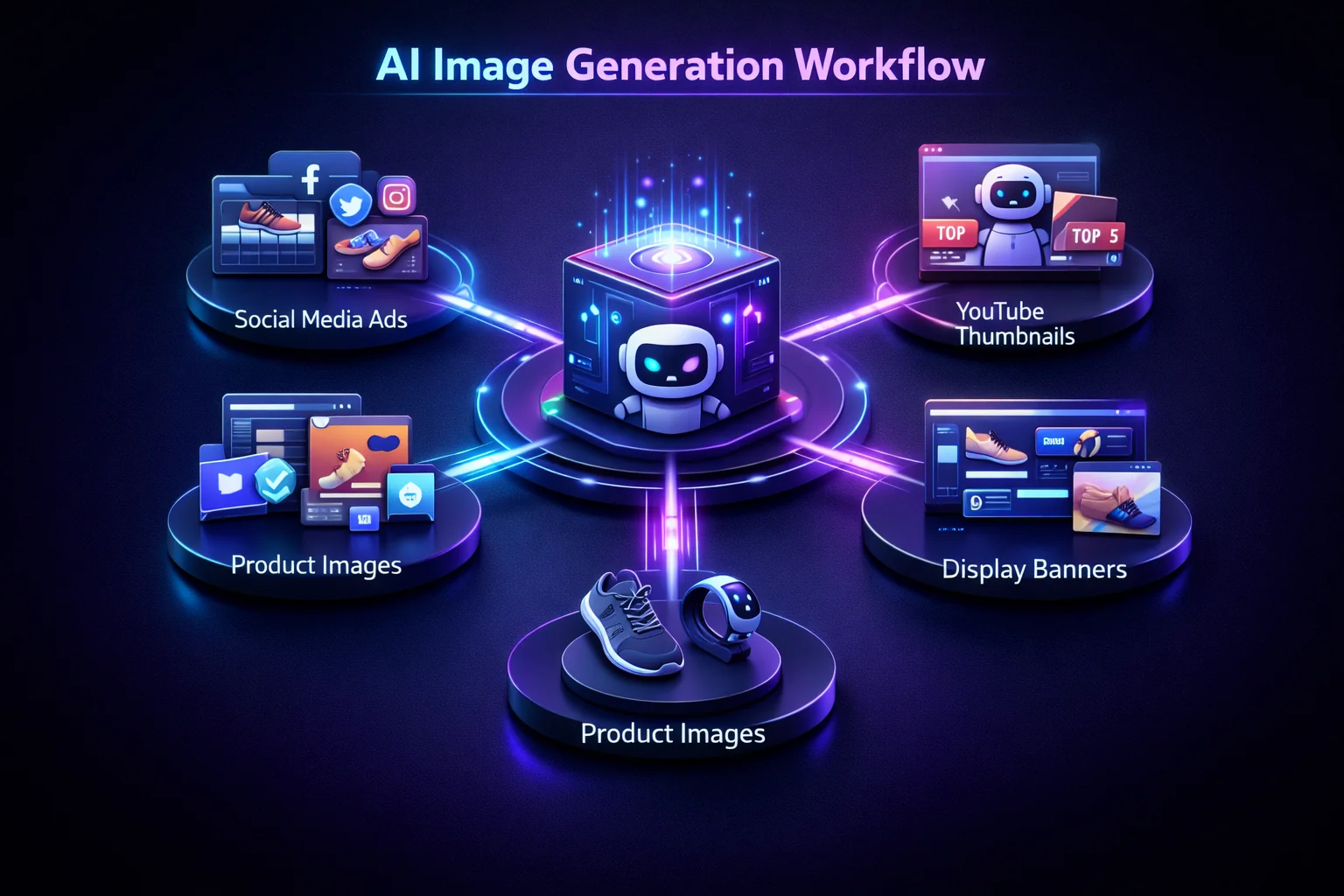
Integrated Asset Production: A single AI workflow capable of generating platform-specific creative assets—from high-converting social ads to detailed product photography.
All pricing reflects official starter plans as of April 2026. Free tiers are noted where available.
Midjourney — Best Overall for Marketing Creative#
Midjourney produces the highest-quality AI-generated images available to non-technical teams. The visual output is cinematic, detailed, and stylistically versatile — capable of producing everything from photorealistic product mockups to editorial illustration styles.
It operates through Discord, which feels unconventional at first. But once you've spent a few sessions learning the prompt structure, it becomes intuitive fast.
Key Features:
- Photorealistic and artistic image generation from text prompts
- Detailed style control (lighting, composition, aspect ratio, aesthetic reference)
- V6 model delivers the strongest quality in its class
- Strong community with shared prompts and style references
Pricing: From $10/month (Basic), $30/month (Standard), $60/month (Pro)
Pros:
- Consistently the highest output quality for marketing creative
- Versatile across industries and visual styles
- Active community makes learning faster
Cons:
- Discord-based interface — not as intuitive as browser tools
- Commercial rights vary by plan — verify before using in paid campaigns
- No direct design editor; output requires finishing in another tool
Best For: Marketers who need premium-quality visual assets for brand campaigns, ad creative, and content marketing.
DALL·E — Best for Content Teams#
DALL·E (now integrated into ChatGPT and the OpenAI API) is the most accessible high-quality image generation tool for teams already embedded in the OpenAI ecosystem. It produces clean, commercially usable images and integrates naturally into text-based content workflows.
The images won't always match Midjourney's artistic ceiling — but they're fast, safe, and easy to iterate on without leaving your existing tools.
Key Features:
- Native integration with ChatGPT — generate images mid-conversation
- Strong at photorealistic product and concept visuals
- Edits via inpainting (modify specific regions of an existing image)
- API access for teams building automated content pipelines
Pricing: Included with ChatGPT Plus ($20/month); API pricing by usage
Pros:
- Seamless workflow integration for teams using ChatGPT
- Fast iteration — refine through conversation, not prompt rewrites
- API access enables automation at scale
Cons:
- Creative ceiling is slightly below Midjourney for brand-level work
- Output style can feel slightly clinical in some categories
- Limited style customization compared to Stable Diffusion
Best For: Content teams, SEO teams, and marketers who want fast, reliable image generation within an existing ChatGPT workflow.
Stable Diffusion — Best for Customization#
Stable Diffusion is the open-source image generation model — and for teams with technical capability, it's the most powerful and flexible option available. You can run it locally, fine-tune it on your brand's visual style, and generate images with no usage limits or per-generation fees.
The learning curve is real. But the ceiling is also the highest in this category.
Key Features:
- Open-source, self-hostable — no per-image fees at scale
- Fine-tuning capability: train the model on your brand's visual style
- Extensive plugin ecosystem (ControlNet, LoRA, img2img)
- Available via hosted platforms (Automatic1111, ComfyUI) for non-technical users
Pricing: Free (self-hosted); hosted versions from $10/month
Pros:
- Unlimited customization — fine-tune to match your exact brand aesthetic
- No commercial licensing restrictions on most model variants
- Strongest community of developers and power users
Cons:
- Significant setup complexity for self-hosted versions
- Requires technical knowledge to unlock full capability
- Quality is highly dependent on prompt skill and model selection
Best For: Marketing teams with technical resources who need fully customized, brand-consistent image generation at scale.
Adobe Firefly — Best for Commercial Safety#
If you're producing images for paid campaigns, licensed content, or any context where copyright exposure is a real concern, Adobe Firefly is the safest choice in this list.
Firefly is trained exclusively on licensed and public domain imagery — meaning every output is commercially safe by design. It integrates directly into Photoshop and Express, making it the natural choice for teams already working in the Adobe ecosystem.
Key Features:
- Trained on licensed content — commercial use safe out of the box
- Deep Photoshop integration (Generative Fill, text-to-image within existing designs)
- Adobe Express integration for quick social and ad creative
- Consistent brand style alignment tools
Pricing: Included with Adobe Creative Cloud plans (from $59.99/month); standalone plan from $4.99/month
Pros:
- The most legally defensible AI image tool for commercial campaigns
- Seamless integration into existing design workflows
- High-quality output for product and lifestyle imagery
Cons:
- Creative range is somewhat narrower than Midjourney
- Full value requires Adobe Creative Cloud investment
- Less community-driven prompt sharing than other tools
Best For: Brands, agencies, and in-house teams producing content for paid media who need guaranteed commercial licensing.
Canva AI — Best for Beginners#
If you've never generated an AI image before and you want results today, start with Canva. The AI image generation is built directly into the design canvas — you generate, resize, adjust text, and export in the same tool, with no context-switching required.
The output quality won't compete with Midjourney or Firefly at the top end. But for social posts, basic ad creative, presentation visuals, and everyday marketing content, it's more than sufficient — and the speed advantage for non-designers is significant.
Key Features:
- Text-to-image generation inside the Canva design canvas
- Magic Media suite: text-to-image, text-to-video, background removal
- 1,000+ AI-integrated templates for social, ads, and email
- Collaboration tools for team content workflows
Pricing: Free plan available; Canva Pro from $15/month
Pros:
- The most beginner-accessible tool in this list
- All-in-one: design, image generation, and publishing in one place
- Free tier makes it genuinely usable before committing
Cons:
- Image generation quality has a lower ceiling than dedicated tools
- Limited fine-tuning for brand-specific visual styles
- Less powerful for technically complex or photorealistic output
Best For: Small business owners, solo marketers, and social media managers who need consistent visual content without a design background.
Leonardo AI — Best for Consistent Brand Visuals#
Leonardo AI sits between the beginner accessibility of Canva and the power of Stable Diffusion. It offers fine-tuning capability, model selection, and detailed prompt controls — all inside a clean browser interface that doesn't require technical setup.
For marketing teams who need visual consistency across a campaign — same style, same character design, same aesthetic — Leonardo's fine-tuning and "Image Guidance" features deliver results that most other tools can't match out of the box.
Key Features:
- Multiple model options — photorealistic, artistic, 3D, and more
- Fine-tuning on custom datasets (brand visuals, product images)
- Image-to-image generation for style-consistent variations
- Canvas editor for layout and composition adjustments
Pricing: Free tier available (150 tokens/day); paid plans from $12/month
Pros:
- Strong consistency for campaign visual series
- Browser-based — no local setup required
- Generous free tier for testing
Cons:
- Token-based system can feel limiting on intensive projects
- Learning curve for advanced features (fine-tuning, ControlNet)
- Output quality varies by model selection
Best For: Marketing teams producing visual series, campaign creative, and brand-consistent imagery who need more control than Canva without the complexity of Stable Diffusion.